The formula at a glance
| Label detail | What the supplied image states |
|---|---|
| Serving size | 1 capsule; 30 servings per container |
| Herbal blend | 350 mg total: Mimosa pudica seed extract, cranberry extract, bearberry leaf, granular berberine hydrochloride extract 8% |
| Probiotic blend | 50 mg total: L. crispatus LCr86, L. acidophilus LA88, L. plantarum N13, L. gasseri LG08, L. casei LC16 |
| Other ingredients | Gelatin capsule, brown rice flour, magnesium stearate, olive oil, silicon dioxide |
| Not disclosed | Individual blend ingredient weights; probiotic CFU count |
This page interprets the formula. The Supplement Facts page preserves a readable label image and transcription, while the individual research guides explore evidence questions in more detail.
Herbal ingredients
| Ingredient | What to investigate | Research guide |
|---|---|---|
| Mimosa pudica seed extract | Plant part, preparation, and human outcomes | Mimosa pudica |
| Cranberry extract | Extract weight, PAC measurement, and the exact outcome studied | Cranberry |
| Bearberry leaf | Preparation, safety restrictions, and duration | Bearberry |
| Berberine hydrochloride extract | Actual amount, medicine interactions, and relevant evidence | Berberine |
Names that look familiar can conceal important differences. A root extract is not automatically equivalent to a seed extract. A study of one standardized preparation does not establish the performance of every blend containing the same plant name.
The five-species probiotic blend
The label lists L. crispatus LCr86, L. acidophilus LA88, L. plantarum N13, L. gasseri LG08, and L. casei LC16. We cover these together in a strain and CFU guide rather than creating five near-identical pages. That keeps the central question visible: does evidence match the actual strain and preparation?
The absence of a disclosed CFU count makes a direct potency comparison difficult. Adding the number of species is not a substitute for knowing their amounts, viability, or relevance to the outcome you care about.
From an ingredient paper to a product decision
- Check that the paper studies humans and the relevant condition.
- Match the plant part, extract, or probiotic strain.
- Compare the actual dose and route of administration.
- Read the measured outcome rather than only the study title.
- Look for a trial of the finished combination, not just a list of references.
For example, a trial measuring recurrent infections cannot be rewritten as a trial measuring fewer stress leaks. The outcome must match the claim. The mechanism guide applies this approach to the seller’s narrative.
Practical questions before purchase
Ask the seller for the latest label, per-ingredient quantities where available, probiotic CFU information, and finished-product testing documentation. Distinguish a laboratory certificate about contents from a clinical trial about effects. Each answers a different question.
If a seller cannot provide a detail, record it as unknown. Do not interpret the omission as proof of harm or proof of benefit. For interactions and individual suitability, a clinician or pharmacist needs the complete formula and your medication history.
Frequently asked questions
Are the ingredient amounts fully disclosed?
No. The supplied label shows totals for two blends, but not separate weights for each ingredient.
Does “clinically researched ingredients” mean the formula is clinically proven?
No. Evidence for an ingredient and evidence for the exact finished formula are different.
Continue your research
Ready to check the details?
Review the current label, package, and final checkout terms before deciding.
View current purchase pageAffiliate link · Opens an external purchase page.
References & source notes
- Supplied FEMICORE product label. Accessed September 25, 2026.
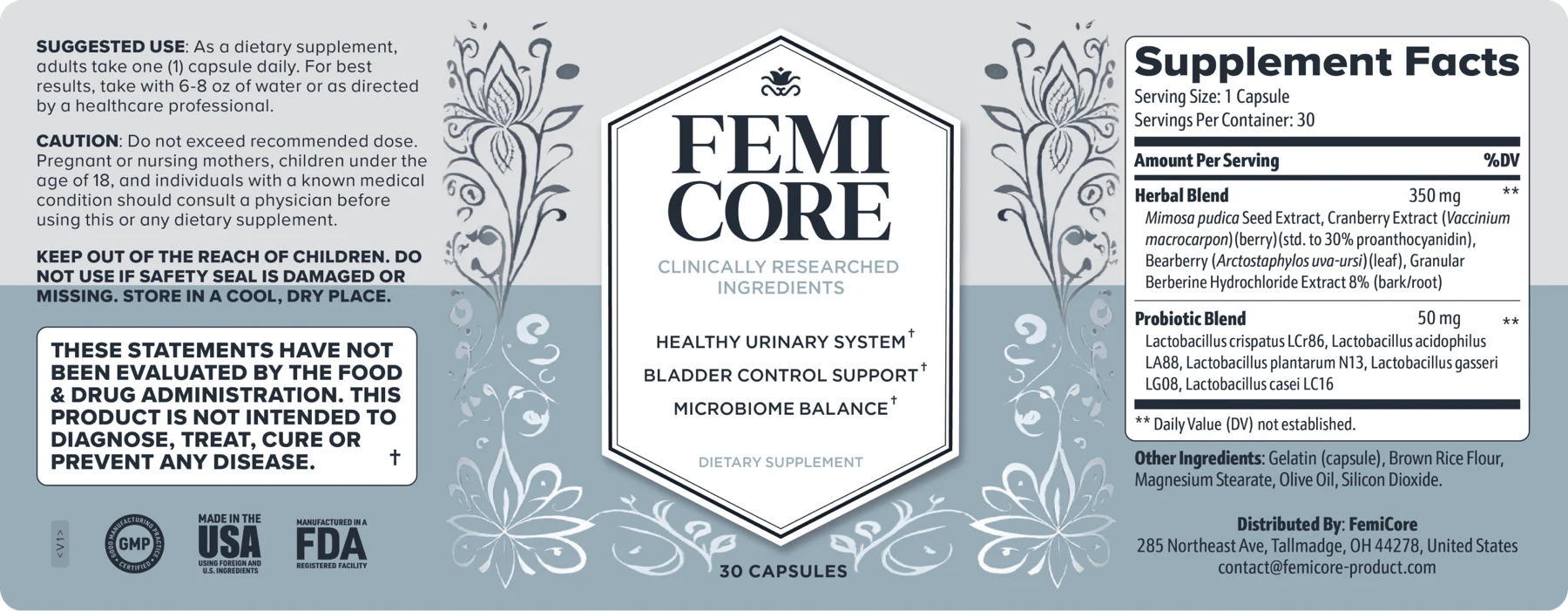
Label information comes from the supplied artwork. Seller claims are not independent clinical evidence. Sources do not imply endorsement of this site or FEMICORE.