The five declared identities
| Label name | Identifier | Question for evidence review |
|---|---|---|
| L. crispatus | LCr86 | Does the study use this identifier? |
| L. acidophilus | LA88 | Is the preparation and route the same? |
| L. plantarum | N13 | Does the measured outcome match the claim? |
| L. gasseri | LG08 | Is viability specified through expiry? |
| L. casei | LC16 | Is the amount comparable? |
These are transcriptions of the supplied artwork, not independent confirmation of organisms in a tested batch. The distinction is important when deciding what evidence is still needed.
Species is not the whole identity
NIH ODS explains that probiotic effects can be specific to strains and conditions studied, and that live organisms are commonly quantified in colony-forming units. A benefit associated with one strain cannot automatically be assigned to another member of the same species.
[probiotics]For this reason, five almost identical “ingredient benefits” pages would give an inflated impression of evidence. This single guide keeps the formulation questions together while preserving each label identifier.
Mass and viability answer different questions
A milligram figure measures mass. A CFU figure estimates viable organisms under the test conditions. There is no universal conversion from one to the other. The label does not show enough information to calculate a live count for each strain or the mixture.
Ask whether any count is stated at manufacture or guaranteed through expiry, what storage is required, and whether the seller can document the current batch. A larger species count is not itself a measure of effectiveness.
Match route and outcome
An oral capsule, a locally administered preparation, and a fermented food are different interventions. Research on one should not be silently transferred to another. Likewise, changes in bacterial measurements, infection recurrence, digestive symptoms, and incontinence are different outcomes.
A relevant claim needs the exact strain or justified formulation match, the dose, the population, and a meaningful outcome. The urinary microbiome article explains why an association between bacteria and symptoms does not establish that supplementation will reverse those symptoms.
Before considering the blend
Review the whole FEMICORE formula, including its herbs and other ingredients. Probiotic language does not remove the need to consider the rest of the capsule. Discuss use with a professional if your medical circumstances make supplement decisions more complex.
The evidence reviewed here does not establish a finished-product clinical benefit. We therefore do not publish a success percentage, a guaranteed time to results, or a claim that the blend “restores” a particular person’s microbiome.
Continue your research
References & source notes
- Supplied FEMICORE product label. Accessed September 25, 2026.
- NIH ODS: Probiotics fact sheet. Accessed September 25, 2026.
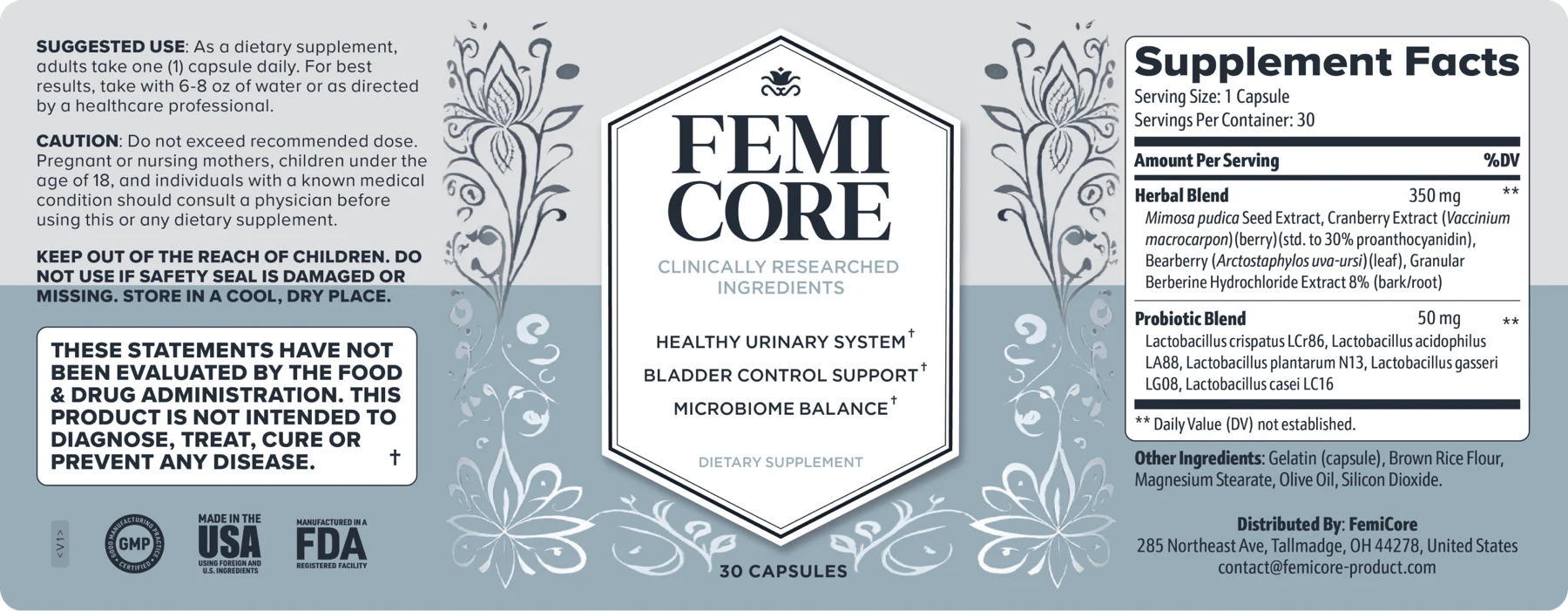
Label information comes from the supplied artwork. Seller claims are not independent clinical evidence. Sources do not imply endorsement of this site or FEMICORE.